How Architectural Shape Affects the Brain: The Neuroscience of Curves, Corners, and Interior Form

Walk into a cathedral with soaring arches, a wellness spa with soft flowing forms, then compare that to a concrete corridor of sharp angles. Both may be functional. But they don't feel the same — and research suggests there is a biological reason why.
How does architectural shape affect the brain? Architectural form — the shapes, angles, curves, and volumes of a space — influences human emotional response before conscious aesthetic judgment occurs. Research in neuroarchitecture shows that the brain processes the geometry of a room through visual pathways connected to emotional centers, meaning a curved hallway and a sharp-cornered corridor can produce measurably different physiological responses before you've had time to consciously decide how you feel about them. Shape is not neutral. It is neurological.
See how Soma Atelier uses form and architectural detail to support human wellbeing
"Our environment is constantly influencing how we feel. The best design doesn't just solve practical problems — it supports human wellbeing."
How Does the Brain React to Architectural Shape?
Research suggests that humans show a consistent preference for curved forms over sharp, angular ones. In a 2006 study published in Psychological Science, researchers Moshe Bar and Maital Neta found that people reliably preferred curved versions of objects over their angular counterparts — and that this preference was associated with activation of the amygdala, the brain's threat-detection center, in response to sharp, angular stimuli.
The evolutionary logic is straightforward: throughout human history, sharp points and angular objects were often associated with potential harm — thorns, teeth, shards, weapons. The brain developed rapid threat-detection pathways that respond to these forms before conscious thought can intervene. Even in the safety of a contemporary interior, the geometry of a room may be activating these same ancient pathways — subtly, below the level of awareness, but measurably.
Why Do Curved Spaces Feel More Welcoming and Comfortable?
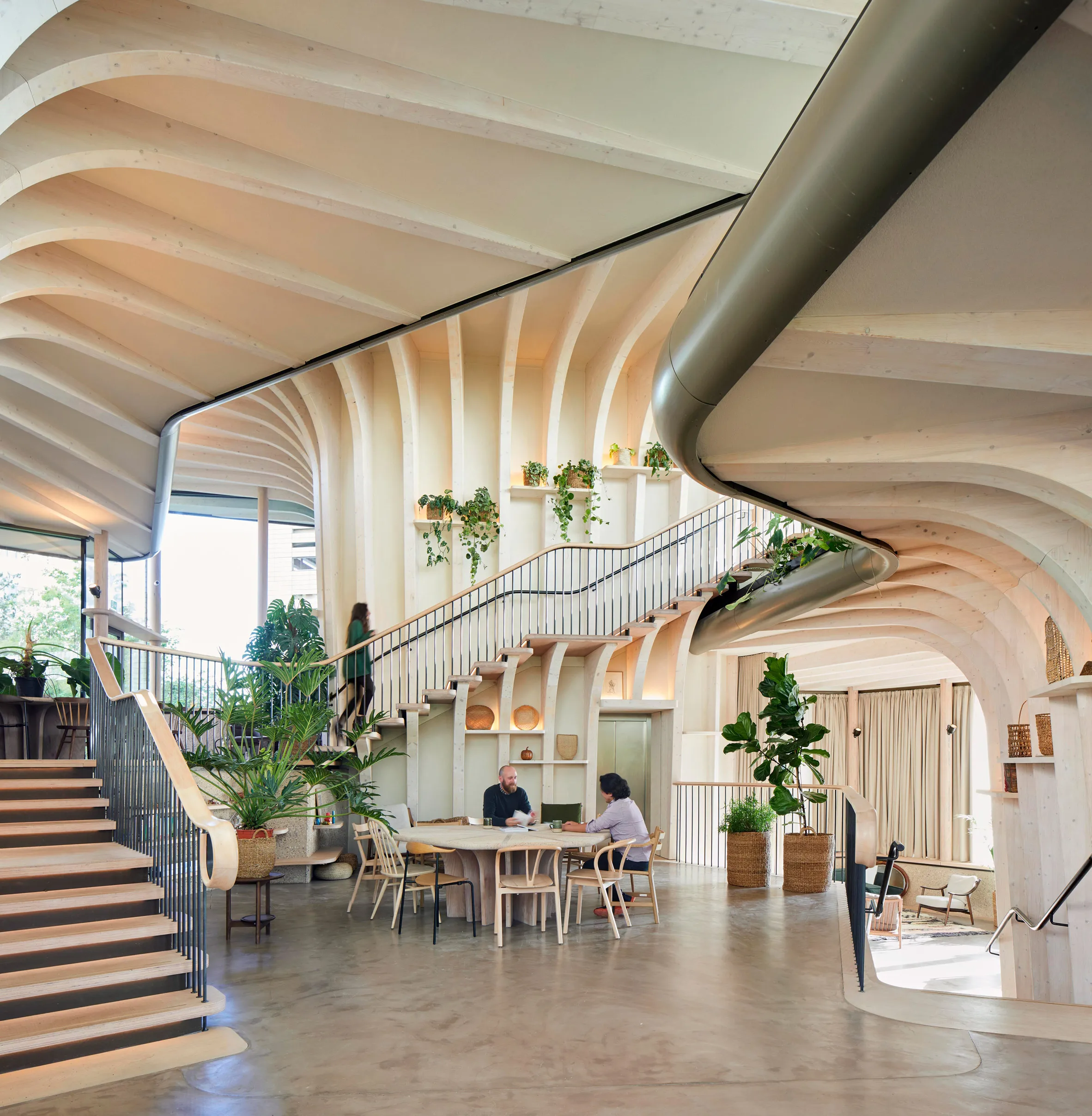
Think about where curves appear in nature: rivers, clouds, hills, leaves, waves, human faces, the horizon. The natural world is composed predominantly of organic, flowing forms. As a result, curved shapes feel familiar and safe — they match the visual language of the environments in which human perception evolved. Curved forms also encourage the eye to move smoothly through a space. There is a visual softness that the nervous system registers as welcoming — an invitation rather than a warning.
Many people describe curved environments as comfortable, approachable, and human-centered. These descriptions are not merely subjective. They reflect genuine differences in how the brain's threat-detection systems respond to the geometry of their surroundings.

Can Too Many Hard Edges in a Room Cause Stress?
This doesn't mean corners are bad. Architecture requires structure — walls meet, furniture needs stability, geometry defines space. The issue isn't the presence of angles. It's their dominance within the space. When a space is filled with rigid lines, repetitive geometry, harsh transitions, and no organic softness to counterbalance, it can register as cold, institutional, or subtly tense. Many older office buildings, hospitals, and commercial spaces prioritized efficiency over human experience — and the result was environments that felt sterile rather than supportive. The people working and healing inside them felt the difference, even when they couldn't name it.
How Do Curves Affect the Way We Move Through Space?
Curved spaces guide movement differently than angular ones. Think about walking along a winding garden path — you instinctively want to see what lies around the next bend. The curve creates a sense of discovery and draws you forward. Sharp lines tend to communicate direction with finality: go here, stop there. Curves tend to communicate journeys. This difference affects not just how people navigate a space but how long they linger in it, how they feel while doing so, and whether the space invites them to slow down or signals that they should move through quickly.
Three Principles for Balancing Shape and Form
- Structure with softness: The most successful spaces combine angular structure with curved softness. Neither extreme alone creates the ideal human environment — rigid geometry feels cold; formlessness without structure feels unsettled. The goal is a considered balance, where curves provide the warmth and geometry provides the clarity.
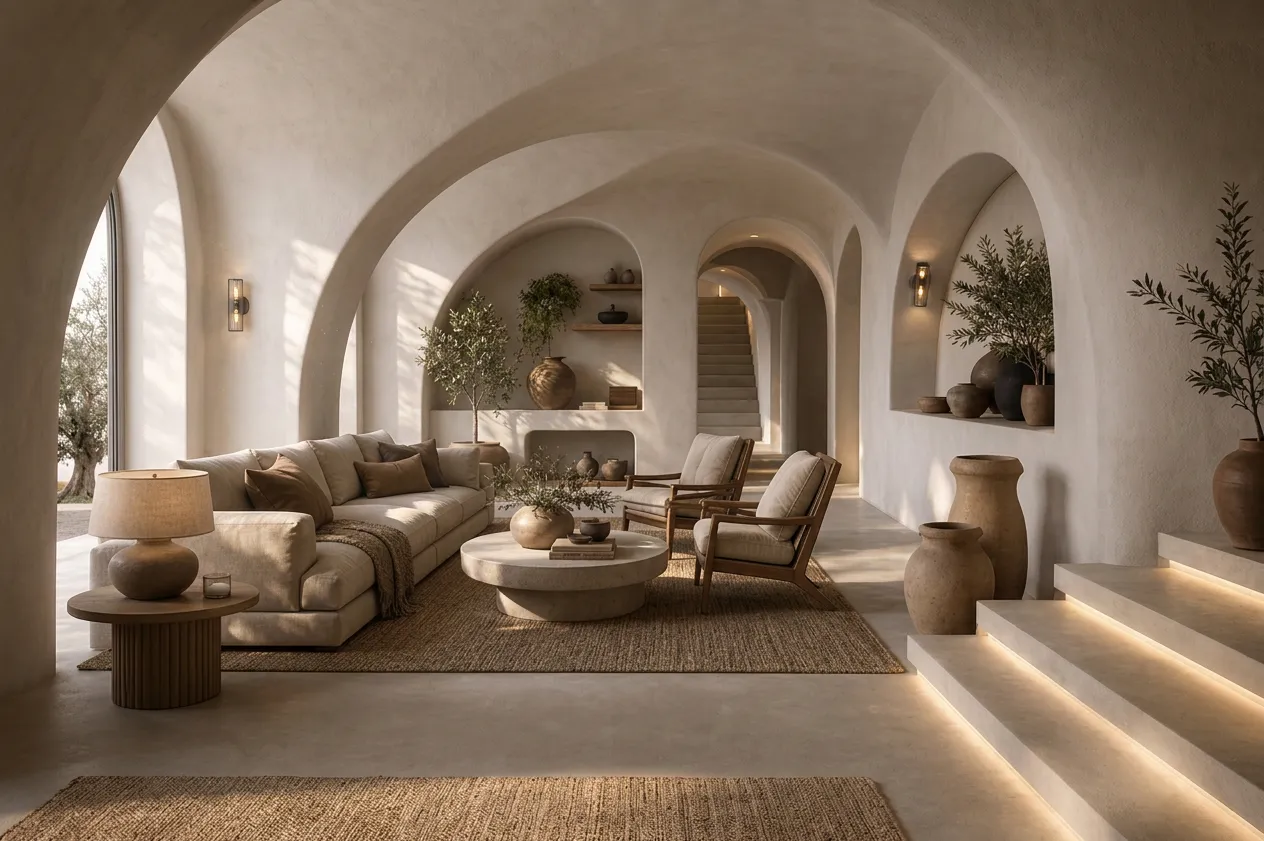
- Arches over corridors: A curved hallway or arched threshold transforms a transitional space from purely functional into something that invites movement and discovery. It is one of the most impactful and cost-effective interventions available in an existing home.
- Rounded furnishings in rectilinear rooms: Even in a fully angular architectural shell, introducing one curved sofa, rounded dining table, or organic mirror can shift the emotional register of an entire space. The brain responds to the ratio of curves to angles in the total visual field — changing even one significant element changes the equation.
"The brain experiences architecture long before we consciously analyze it. Shapes matter. Forms matter. The way a room guides our eyes and movement matters."
Frequently asked questions
How does architectural shape affect the brain and nervous system?
Architectural shape affects the brain through visual pathways connected to emotional processing centers, including the amygdala. Research by Bar and Neta (2006) found that angular, sharp-edged forms activate the amygdala — the brain's threat detection center — more than curved forms do. This means the geometry of a room can trigger measurable differences in physiological stress responses before conscious aesthetic preference has formed. Curved spaces tend to feel safer and more welcoming because they align with the visual language of natural environments where rounded forms signal safety.
Why do curved rooms and spaces feel more welcoming than angular ones?
Curved spaces feel more welcoming because the brain evolved in natural environments dominated by organic, flowing forms — rivers, hills, leaves, clouds — and learned to associate these shapes with safety. Sharp angles, by contrast, are more commonly associated with potential harm in nature: thorns, shards, teeth, weapons. Research shows the amygdala responds to angular stimuli with mild activation even in safe contexts, creating a subtle background alertness that curved forms simply don't trigger.
What does neuroscience say about why we prefer curved forms?
A landmark 2006 study by researchers Moshe Bar and Maital Neta, published in Psychological Science, found that people reliably preferred curved versions of objects over angular counterparts across multiple categories. The preference was linked to amygdala activation in response to sharp, angular stimuli — suggesting the preference for curves reflects genuine threat-avoidance processing rather than simple aesthetic taste. This research provides one of the strongest neuroscientific foundations for the use of curved and organic forms in human-centered design.
How can I make a room with hard angles feel warmer and more welcoming?
In a predominantly rectilinear space, the most effective interventions are: introduce one or more curved furniture pieces (a rounded sofa, an oval dining table, a circular rug); add an arched mirror or arched doorway treatment; use soft, organic textiles that break up the hard geometry; incorporate plants whose irregular, natural forms contrast with architectural angles; and choose decorative objects with curved or irregular shapes over purely geometric ones. Even modest additions in these areas measurably shift the balance of curves to angles in the visual field.
What is the difference between curved and angular interior design in terms of how it feels to live in?
Curved interior design tends to produce environments that feel warmer, more welcoming, psychologically safer, and more inviting of lingering. Angular interior design produces environments that feel more structured, efficient, and directional — qualities appropriate for some spaces but potentially stress-inducing when dominant throughout a home. The ideal approach for most residential spaces is a balance: angular architectural structure provides clarity and definition while curved furnishings, soft textiles, and organic elements provide warmth and ease.